Two Migrations.
Two Completely
Different Problems.
Enterprise migrations are rarely just technical shifts — they are pivotal moments for a brand's digital evolution. Early in my career at Optimum, I navigated the transition from Contentful to Drupal, which coincided with a comprehensive company style redesign. The challenge was twofold: designing an entirely new visual language while simultaneously meeting with developers to map new components to the specific functional limitations of Drupal.
Today, I'm leading the move from Drupal to Adobe Experience Manager (AEM). This shift requires a fundamentally different level of rigor. Unlike the relative flexibility of Drupal, AEM demands absolute precision during the build phase. Every possible state must be hard-coded into the component architecture from day one — there is no "adjusting on the fly."
My value in these migrations is bridging the gap between design intent and backend reality. I build the "Rules of the System" — Variables and Components — and then manage the team to ensure those rules are applied flawlessly at the page level.
Three Constraints.
Three Navigations.
During the Contentful → Drupal migration, we faced a "Visual Parity" challenge. Drupal's backend constraints required real-time adjustments to padding and component behavior that differed from our static Figma designs. The live site and the design frequently diverged.
I represented the UX team during "Live-Audit" sessions with engineering. By looking "under the hood" of the CMS alongside developers, I made surgical tweaks to design specifications — container logic, padding, component behavior — ensuring the live build matched our Figma intent as closely as possible.
Transitioning to AEM introduced a shift from "flexibility" to "precision." Unlike Drupal, where color variations and backgrounds could be adjusted on the fly, AEM requires every possible state — every color variant, every size — to be pre-authorized in the component architecture from day one.
I overhauled our handoff protocol. I introduced a Variable-Driven Library that explicitly mapped every breakpoint, color variant, and component size — ensuring every design element was "pre-authorized" in the AEM build, preventing future "new component" tickets for simple style changes.
The Fixed Business team transitioned to AEM first with a blank slate. The Mobile team, however, had to migrate a massive library of existing, complex legacy designs — a fundamentally harder problem requiring a "structural upgrade" rather than a clean-slate build.
I performed a "Platform Gap Analysis" — documenting exactly how AEM ingestion differed from Drupal. This ensured the Mobile team's migration wasn't a "lift and shift," but a structural upgrade that leveraged AEM's cleaner architecture for better long-term site performance.
Designing for
CMS Logic.
As solo lead, I created a new component library specifically tailored for the Drupal migration. This required a deep "Data-to-Design" relationship — working with engineering to ensure new brand styles didn't break under CMS constraints. Creative redesign and platform migration executed simultaneously.
I personally architected the foundational library and variable components to meet AEM's modular requirements. To scale the effort across thousands of pages, I mentored and managed a designer on the Mobile team to handle instance populating within the final AEM handoff files.
Every State.
Pre-Authorized.
For the AEM transition, I moved away from "general" specs to highly specific documentation that mirrors AEM's native component logic. Every visual option — every background variant, layout state, and responsive breakpoint — is explicitly documented so developers have no guesswork.
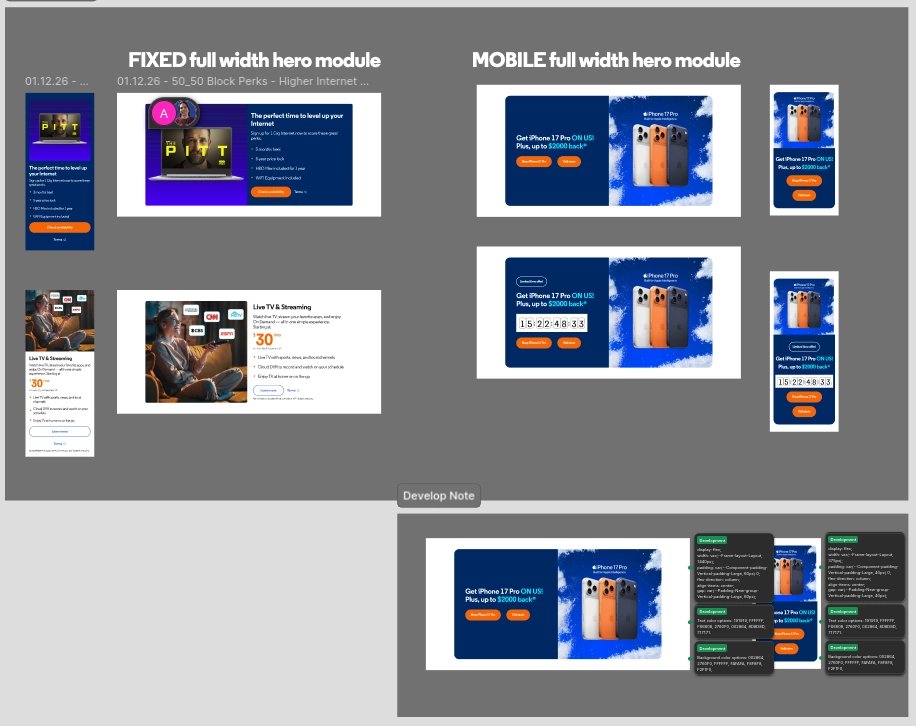
All migrating pages were documented with complete component option matrices — every visual variant displayed explicitly for developers to ensure nothing is missed in the final live deployment. Mobile-specific pages were flagged for higher build priority.
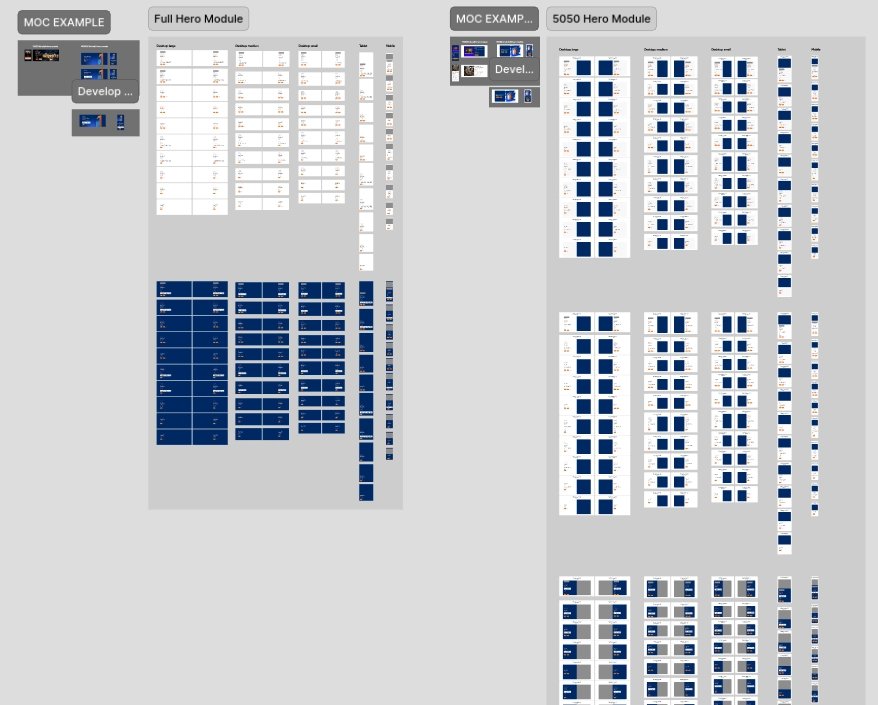
While Drupal allowed for "on-the-fly" adjustments, AEM rewards architectural foresight. By delivering precise, variable-backed specs now, I'm ensuring a level of cross-platform consistency that was previously impossible in our legacy systems.
Parity at Scale.
migrations led
target for AEM rollout
covered
developer handoff
Redesign Success: Successfully launched a new company visual style during the Drupal migration without disrupting the content model — creative transformation and technical migration executed simultaneously.
Parity at Scale: On track to achieve 1:1 design-to-code parity for the AEM rollout, covering thousands of enterprise-level pages. The variable-backed handoff eliminates the "design QA" cycle that previously consumed weeks per release.
Effective Delegation: Scaled the AEM project by architecting the system solo and then managing a designer to execute the high-volume page population — maintaining architectural oversight while enabling team execution.